SEO for Personal Brands: Turning Years of Content Into Google and ChatGPT Traffic
Most solopreneurs and personal brands already have the content to rank. Here's how Adam Cortez's agency used OpenSEO and Claude to get a coach's podcasts and posts back into Google and cited by ChatGPT.
By Ben Senescu
If you run a personal brand, you may already have years of podcasts, videos and posts on your site. Most of it has never been optimized, so it brings in less search traffic than it could. Adam Cortez, founder of the San Jose agency ARC Creative Co., fixed this for one of his clients, a coach with years of content, using OpenSEO and Claude. After one cleanup sweep in August, Google picked the site back up. New visitors are now about double what they were a year earlier, and ChatGPT and Perplexity cite him as a resource.
Who this is for and what you'll learn
This post is for solopreneurs whose business runs on their name, like consultants, coaches, creators and authors, and for the agencies that do their SEO. The client happens to be a dating coach, but the same steps work for anyone with a backlog of content. You'll learn:
- How to audit years of posts, podcasts and videos and fix them in one sweep.
- How to plan new content around the questions people ask, so ChatGPT and Perplexity cite you.
- When city pages work for a business that serves people anywhere.
- Which parts of the work still need a person.
A personal brand with more content than anyone could optimize
For a solopreneur, the website is less about a "book a call" button and more about being the person people find when they have a question. That's how Adam thinks about this client. ARC has done his SEO for about seven years, and it always went well, until Google's algorithm changes about a year ago hit his traffic hard.
He had no shortage of content. He has a podcast, every episode becomes a transcript on his site, and he publishes a weekly post on top of that. The problem was that nobody could keep up with optimizing it all by hand.
The content also competed with itself. ARC kept a huge keyword map in a spreadsheet to track which page should rank for what. Even so, when he launched his podcast, the keyword he wanted the podcast page to rank for got picked up by an older blog post instead.
Auditing years of content with OpenSEO and Search Console
Adam's team had OpenSEO analyze where every page stood, then pulled the same view from Search Console and compared the two. Claude grouped what it found into fixes, in the order they should happen. A person looked over each batch before it went live, and then they resubmitted the pages to Search Console.
The first sweep filled in the cracks from years of publishing:
- Posts competing for the same searches, fixed first.
- Missing meta descriptions.
- Missing schema.
- Missing alt text on images, which mattered because every post had images.
None of this is new SEO advice. What's new is that one sweep can cover hundreds of pages, which used to be too much work for a solopreneur or a small agency. The SEO Audit skill runs this kind of audit, and the technical SEO audit checklist covers what to look for.
Planning content around the questions people ask
A personal brand gets found when people ask questions. So ARC now plans most new content from the questions a page can answer, so ChatGPT, Perplexity and Gemini pull it into their answers. They still look for high-volume keywords, but instead of only a keyword map, they keep a question map of what people ask and which page answers it. Long-tail question mining covers how to find those questions.
Self-competition matters less here. An AI answer can cite three of your pages at once, where a Google result usually shows one.
The hard part is checking whether it works. ARC takes the questions they think people ask and checks whether the coach shows up in the answers, and where. Adam says there still isn't a clean way to do that. AI visibility in OpenSEO explains how we approach tracking it.
City pages for a business that works anywhere
The coach is based in one city, but he works with clients everywhere, so ARC built about 200 city pages for him. That works for any solopreneur who serves people beyond their own town, as long as each page is actually about its city.
Before writing, they pull facts about each city from Wikipedia and local databases. Then each page gets local FAQs, a map and real details about the place. OpenSEO's reports also show them what doesn't work: when a competitor publishes 100 location pages with the same generic text, Google ignores them.
Google doesn't care that a page was written with AI or published alongside 100 others. It cares whether the page is useful for people in that place. The Local SEO skill checks Google and Maps rankings by location, and local SEO for service businesses walks through it on a real business.
How ARC runs this for every client
Adam built two Claude skills that use OpenSEO. The first runs on a prospect's URL and checks their keywords, local rankings, site issues, ad tracking and basics like a privacy policy and an up-to-date copyright year. The second runs once a client signs and ARC has Search Console and website access, and produces a full report of about 20 pages.
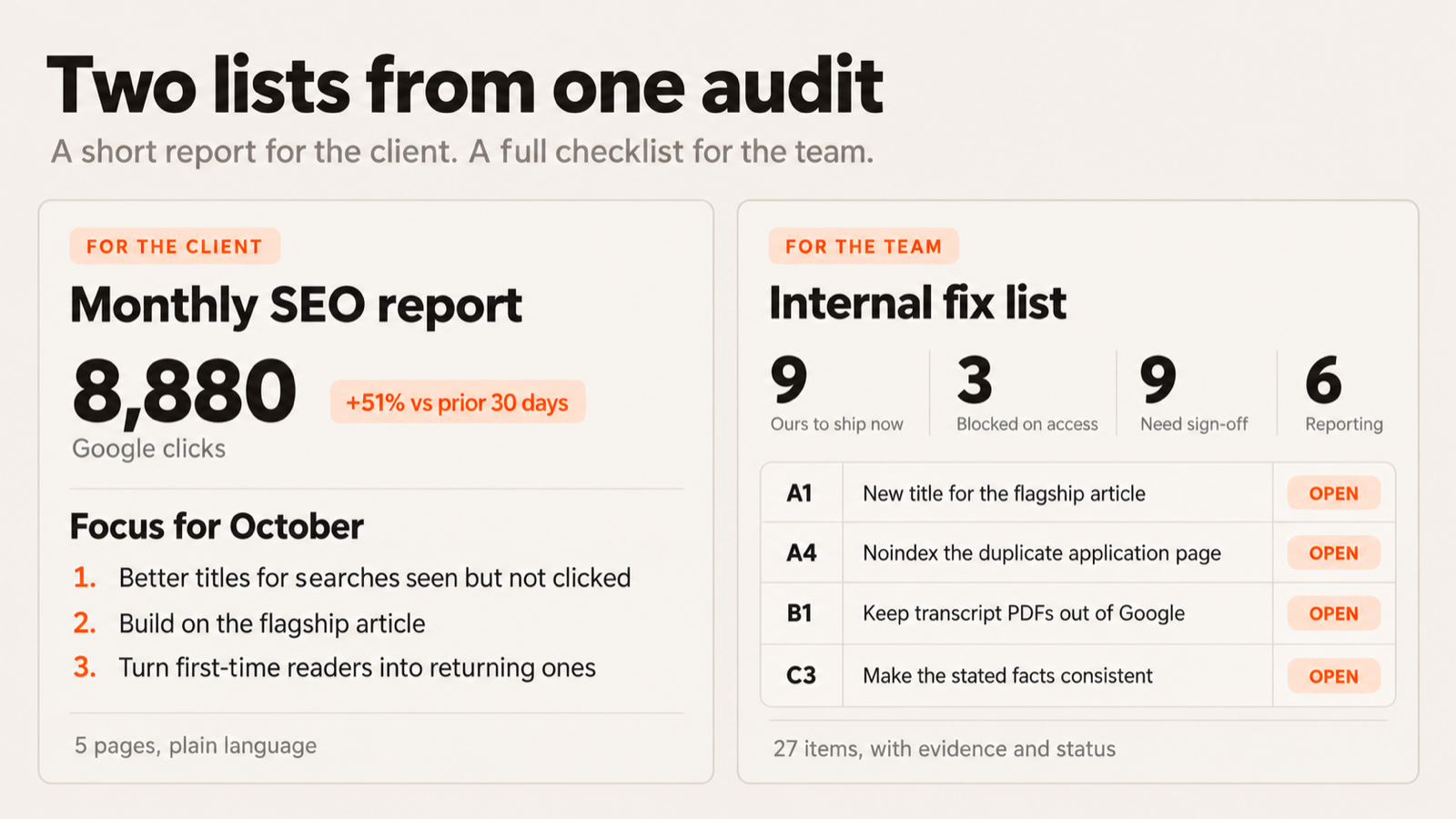
From that report they make two lists: a short one for the client about what's wrong and what will be fixed, and a full checklist for the team. Adam says the two have to be different, because sending a client the full list just scares them. If you're doing this for your own site, you only need the checklist. The SEO Report skill saves reports like these.
What still takes a person
People still review the research. Three or four months ago, about half of what the system produced needed fixing. ARC now collects better information about each client's ideal customer at onboarding, and the output is about 90% right. Human-in-the-loop content covers where that review pays off.
Getting changes onto the site is the other manual part. OpenSEO doesn't edit sites itself yet (it's planned), so ARC has Claude drive Chrome to make changes in the site builder. That works well on Elementor, but Claude locks up on Divi, and Wix and Squarespace are limited.
Results: twice the new visitors in a year
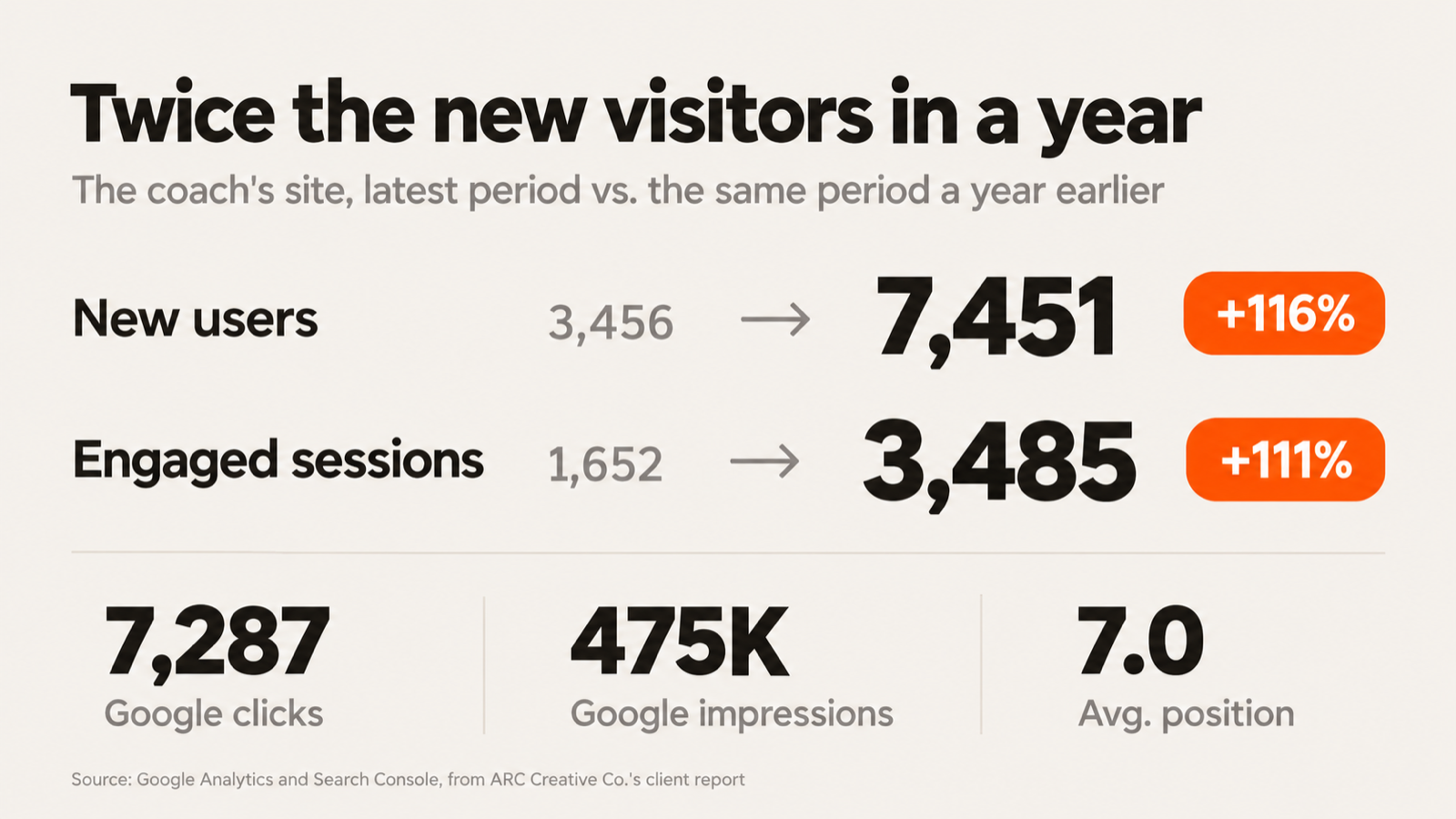
- After the August sweep, Google picked the coach's site back up.
- Compared with the same period a year earlier, new users roughly doubled, from about 3,500 to 7,500, and engaged sessions rose 111%.
- In the latest period the site got about 7,300 clicks from Google on 475,000 impressions, at an average position of 7.
- ChatGPT and Perplexity cite him as a dating resource, not only as a place to book a call.
ARC shares more client numbers on its SEO results page.
Takeaways
- If you run a personal brand, your existing podcasts, videos and posts may be your best SEO asset. Optimize them before making more.
- One audit and fix sweep can now cover hundreds of pages: overlapping posts, meta descriptions, schema and alt text.
- Plan new pages around the questions people ask, so AI answers can cite you as a resource.
- If you serve people everywhere, city pages can work, as long as each one is specific to its place.
- Review what the AI produces, and give it good information about who your customers are.
