Local SEO for Service-Based Businesses: An Owner's Guide
Local SEO for service businesses, worked on a real remodeler: the one Google Business Profile field that cost it half its town, and prompts to check yours.
Google decides whether a service business shows up in the map pack by asking three questions of each search: do you do the thing, are you near the person searching, and do people vouch for you. You control two of them. This guide runs all three on a real remodeler in Cookeville, Tennessee, and gives you the prompts to run the same checks on your own business in OpenSEO.
H&H Construction has a 5.0 rating from ten reviews, and all ten are five stars. It has 35 photos, a claimed profile and 29 services listed, including kitchen remodeling. It passes the checklist most owners get handed.
It still loses the north end of its own town for kitchen remodeling to a showroom with a 4.6. The cause is one field in the profile and a review count the showroom has spent years building.
If you want an agent to do the legwork, connect OpenSEO MCP first so it can pull live profile, map and keyword data. Each step below comes with a prompt you can paste in, and the Local SEO skill runs the profile, competitor and map checks together.
Table of Contents
- How Google picks the map pack
- Local keyword research
- Google Business Profile optimization
- Local rank tracking
- Local competitor analysis
- How to get more Google reviews
- Your local SEO checklist for this week
- Local SEO reporting for agencies and in-house teams
- Why your business isn't showing on Google Maps
How Google picks the map pack: three questions, and you control two
The map pack is the block of three businesses with a map that sits above the regular results when someone searches for a local service. Google's own local ranking page names the factors it uses to fill it: relevance, distance and prominence. For a business that sends a truck, they break down like this.
- Relevance is "how well a Business Profile matches what someone is searching for." That's your categories, your services list and your description. You control all of it, today, for free.
- Distance is how far you are from the person searching. You can't move the shop. You can stop measuring your rankings from inside it, which is the mistake most owners make.
- Prominence is how well-known you are. Google puts it this way: "More reviews and positive ratings can help your business's local ranking." You control this too, over months.
Local keyword research: find the words customers use to hire you
Before you touch your profile, find out what people type when they want to hire you. Your vocabulary and theirs often don't match. We ran H&H's main service, kitchen remodeling, through OpenSEO's keyword research, and this is the raw result:
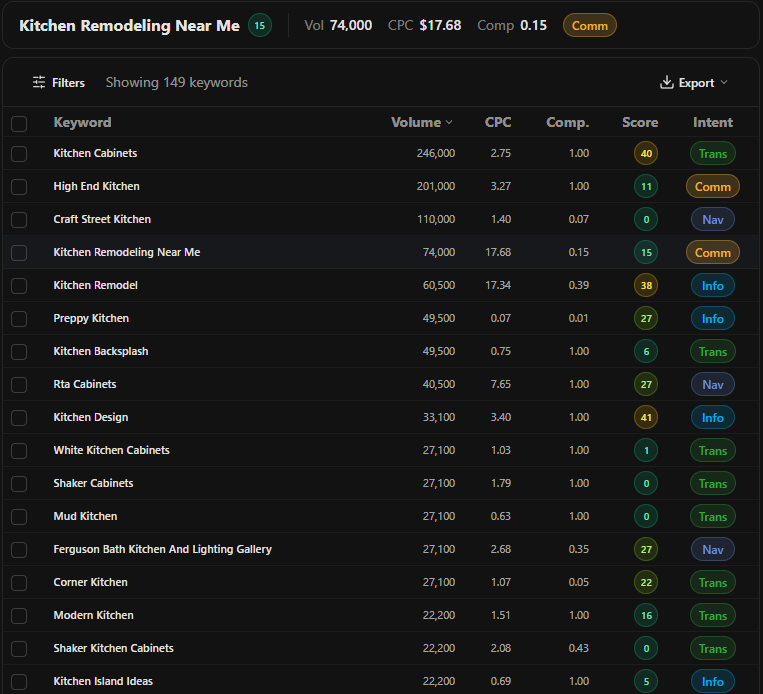
Look at what sits above the one you want. kitchen cabinets at 246,000 a month is people shopping for boxes. preppy kitchen is a cooking channel. kitchen island ideas is somebody on a Sunday afternoon with a Pinterest board. Those searchers aren't hiring a contractor. Ranking for them would put you in front of the wrong half of your audience.
The search that pays is fourth: kitchen remodeling near me, 74,000 a month, difficulty 15. Right behind it are kitchen remodel at 60,500 and kitchen renovation at 18,100. Those three are your customer talking. The rest of the list is noise you'll be tempted to chase because the number is bigger.
Those are national estimates, so use them to learn which words people use. They don't tell you how many of those people live near you. OpenSEO can pull volume for a single city or county if you give it one, at an extra credit cost per seed. For a town the size of Cookeville, expect small numbers, and don't let that scare you off. Jonathan Schüßler, who does SEO for service businesses in Germany, built a wedding photography business on search terms other photographers ignored for being too small:
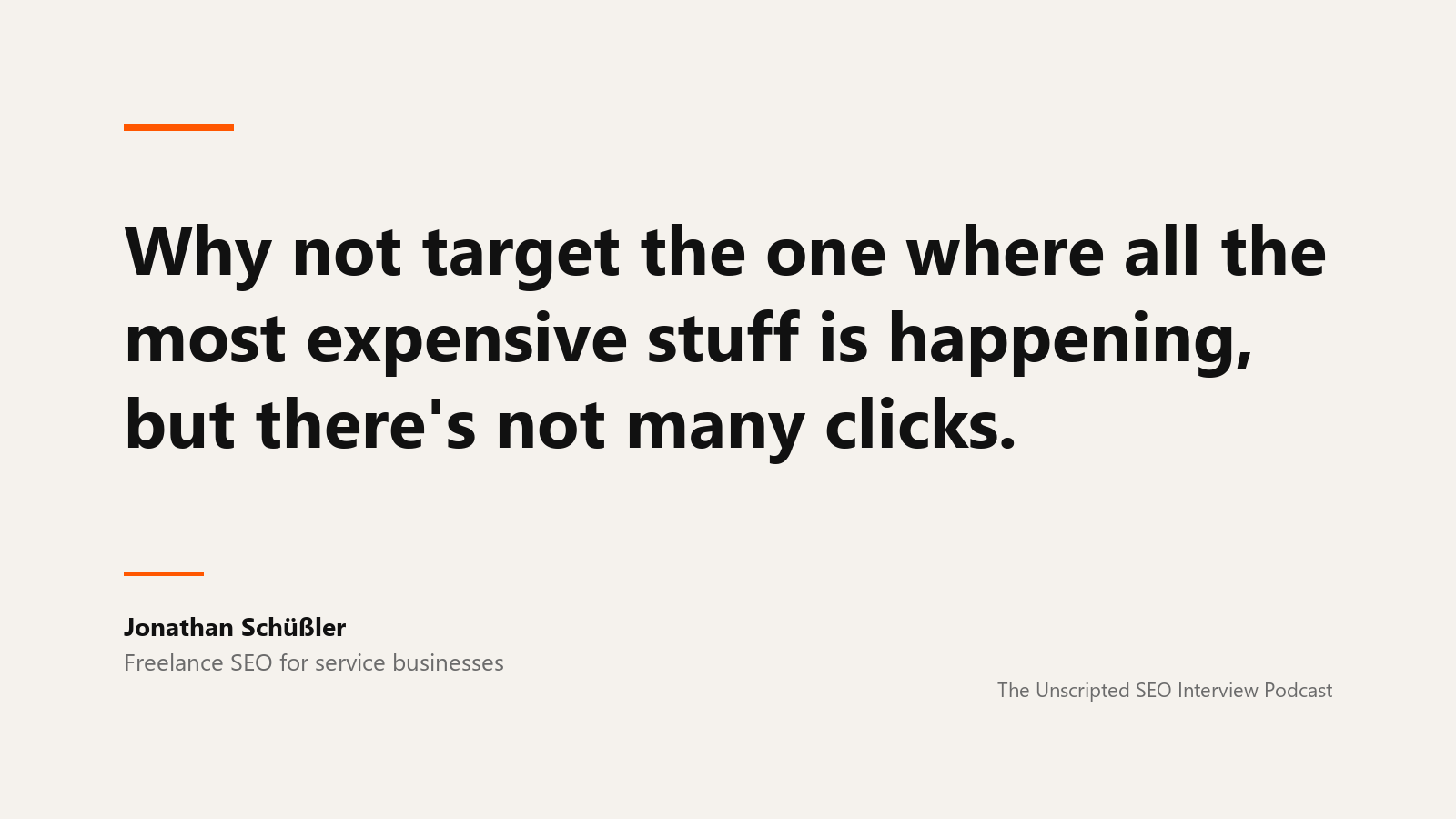
For a remodeler, "where the expensive stuff is happening" is the kitchen and the addition. The drywall patch can wait. Pick the two or three services that carry your margin and do this step for each. The keyword research library goes deeper on seeds and filtering, and the keyword clustering skill will group what's left by service.
Use OpenSEO to research keywords for my business. I'm a [trade] in [town, state].
Seeds: "[main service]", "[second service]", "[main service] near me".
Keep only searches from someone who wants to hire a business like mine.
Drop product shopping, DIY ideas, brand names, jobs and anything about a
different trade. Group what's left by the service it belongs to, and give
me volume and difficulty for each group, highest-value service first.
Google Business Profile optimization starts with your categories
Now pull your own Google Business Profile (called Google My Business until 2021), and read it like a stranger would. This is H&H's profile in OpenSEO as of September 28, 2026:
| Field | H&H Construction |
|---|---|
| Primary category | Remodeler |
| Additional categories | None |
| Rating | 5.0 from 10 reviews, all five stars |
| Photos | 35 |
| Services listed | 29, including Kitchen remodeling |
| What reviewers talk about | communication (4), quality of work (3), reliability (3), kitchen remodeling (2) |
| Hours | Mon–Fri, 9 to 5 |
Hold the second row and the fifth row side by side. H&H sells kitchens: they're in the services list and the description, and customers mention kitchen remodeling in their reviews. The one place it doesn't say "kitchen" is the business category, which says Remodeler, the general parent. Categories are one of the main ways Google matches a profile to a search, so that gap costs more than any of the others.
This is the most common gap you'll find on a trade profile, and the cheapest to close. Owners tend to pick one category at setup, the broadest one that feels true, and don't revisit it. Whoever has a free afternoon fills in the services list later, and checking that the two agree isn't anyone's job.
Use OpenSEO to pull the Google Business Profile for [business name] in
[town, state]. List every service I sell, from my services list, my
description and what my reviews talk about. For each one, tell me whether
my primary or additional categories cover it. Flag any service I sell
that no category names, and suggest the closest Google category for it.
Local rank tracking: check your Google Maps ranking where customers search
If you search for your own service from your office, you'll look great, because you're standing on top of your own pin and your customers aren't. So we checked kitchen remodeling from nine spots around Cookeville, about five miles apart, the way a phone would see it from each one:
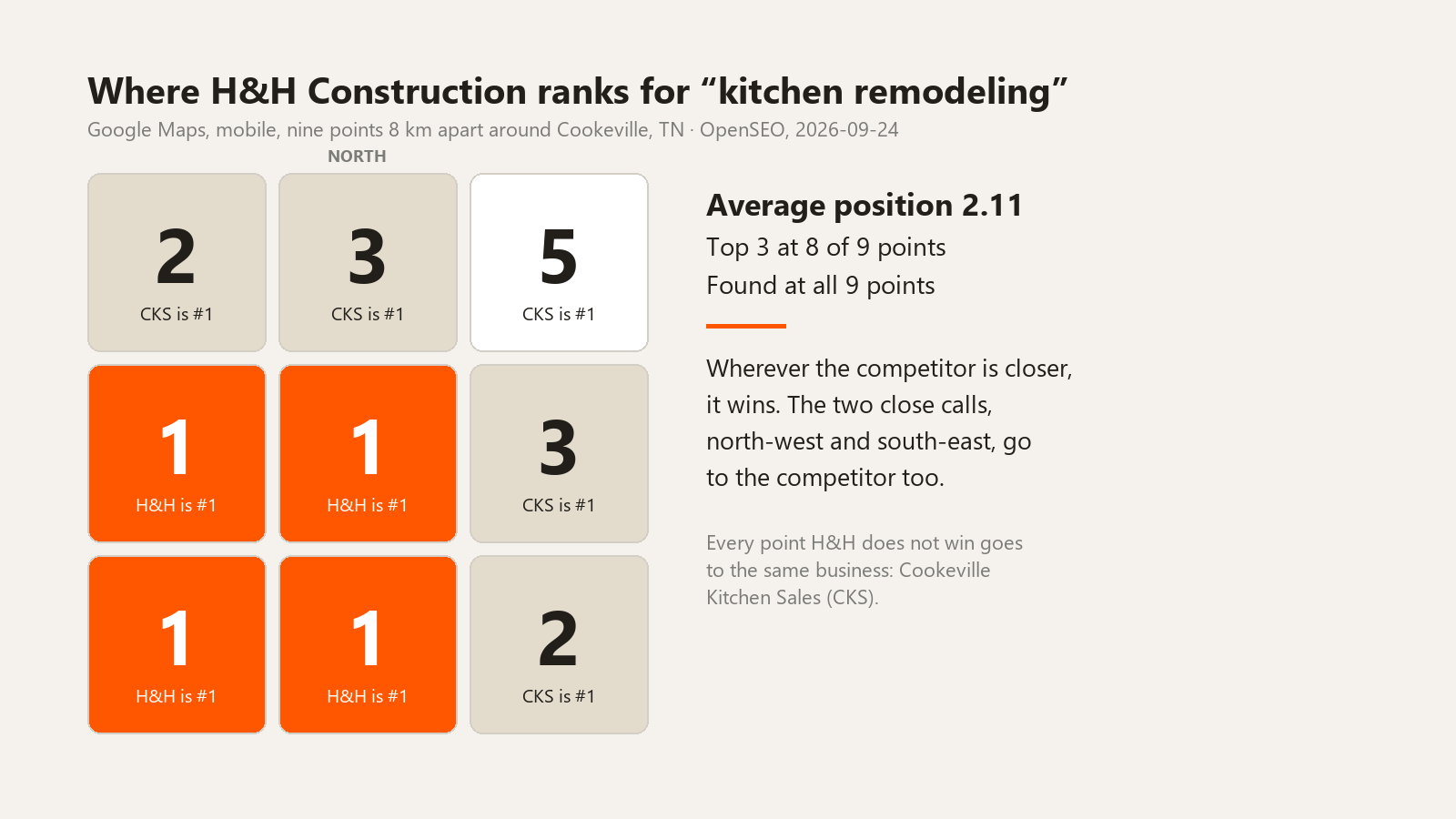
At the front door, first. Due west and due south, first. Drive north-east and H&H slides to third, then fifth. A homeowner in the north end of town searching for a kitchen remodeler sees four other companies before this one, and the same business takes all five points H&H doesn't win.
A single rank check would have told you "you're #1" and you'd have moved on. This is local rank tracking: your Google Maps ranking from nine places instead of one, and it shows you where the jobs are leaking. Each point is one map search, so a 3×3 grid is nine searches and a 5×5 is 25, and each one uses credits. Start at 3×3. The local rank tracking library covers how to size and space a grid for your area.
Check your Google Maps ranking with your phone
Search your main service from three or four different parts of your service area, on your phone, with location on, somewhere other than the shop. Write down where you come up at each stop. If the number gets worse as you drive in one direction, look up who's winning there. That's the business to study next.
Local SEO for service area businesses
Plenty of plumbers, cleaners and landscapers run what Google calls a service area business: no storefront, and the address hidden on the profile. The check works the same way: center the grid on your address anyway, then add a check or two from the towns you most want work from. Those are the points that tell you whether your profile reaches the jobs you're driving to.
Use OpenSEO to run a 3x3 local rank grid for "[main service]" centered on
my business, [business name], at [address], 8 km between points, on
mobile. Show my position at each point. For every point where I'm not #1,
name the business that is, and tell me whether it's closer to that point
than I am.
Local competitor analysis: compare your profile to the business outranking you
Compare against the business taking the points you lost, even if it's smaller than the big names in town. For H&H, that's Cookeville Kitchen Sales, a kitchen showroom 3.9 km north-north-east of H&H's office. The two profiles compare like this:
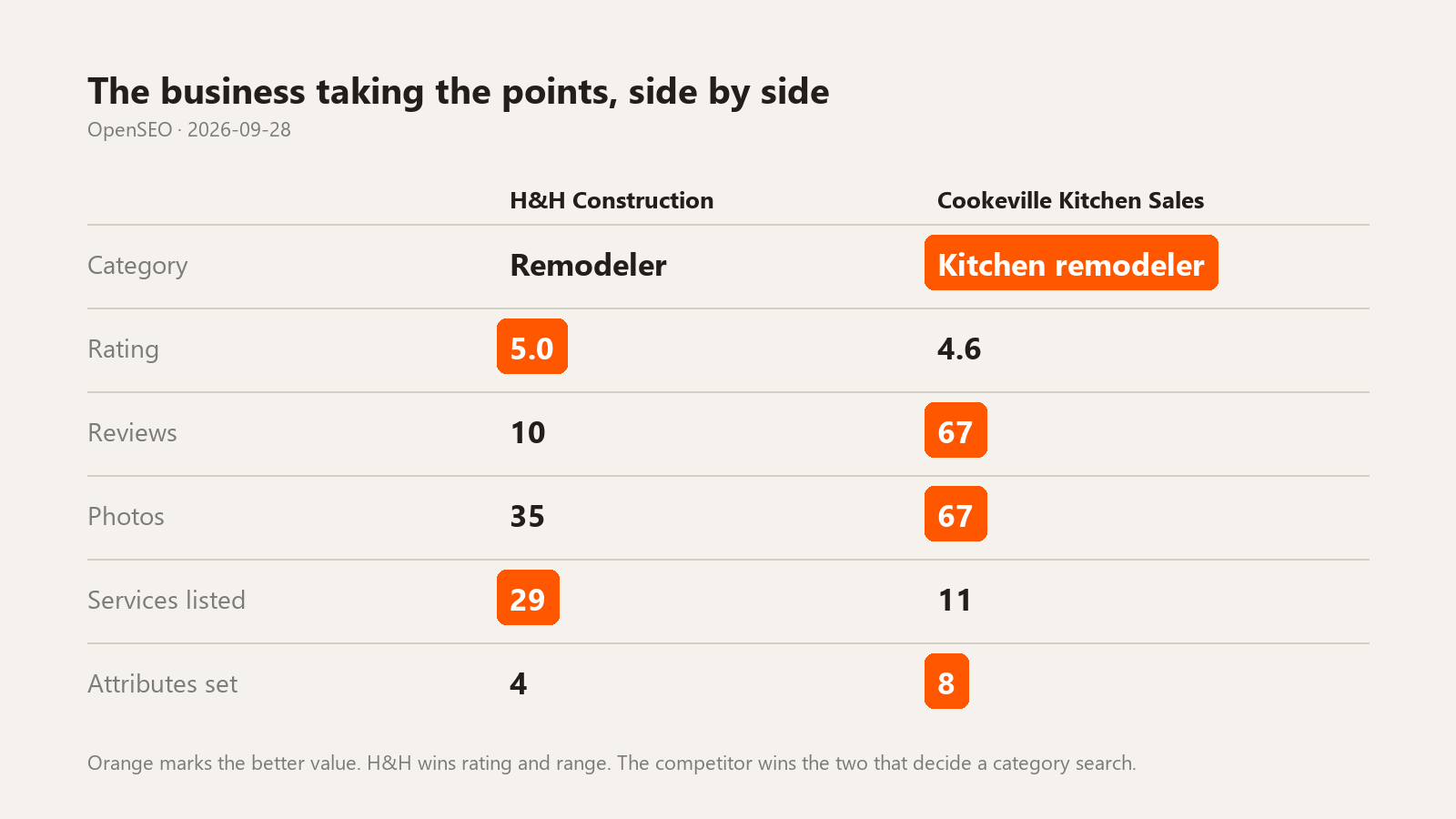
H&H wins on rating and on range of services. It loses on an exact-match category and a review count 6.7 times smaller, which map to two of Google's three factors: relevance and prominence.
Before you blame distance, test it. We measured the straight-line distance from each grid point to both businesses:
| Grid point | To H&H | To the competitor | Who's #1 |
|---|---|---|---|
| North-west | 11.3 km | 11.3 km | Competitor |
| North | 8.0 km | 5.3 km | Competitor |
| North-east | 11.3 km | 7.6 km | Competitor |
| East | 8.0 km | 6.6 km | Competitor |
| West, center, south-west, south | 0–11.3 km | 3.9–15.2 km | H&H |
| South-east | 11.3 km | 12.6 km | Competitor |
Distance explains most of the map. Wherever the showroom is closer, it wins, and no setting will change where it's parked. But look at the two rows in bold. In the north-west the two businesses are the same distance away, and in the south-east H&H is 1.3 km closer. The showroom wins both. On a tie, the business whose category says "kitchen" and whose review count is 67 came out ahead, and you can change both of those.
Use OpenSEO to pull the Google Business Profile for [competitor name] in
[town]. Put it next to mine in one table: primary category, additional
categories, rating, review count, photos, services and attributes. Mark
which of us wins each row. Then tell me which rows I can change this week
and which will take months.
How to get more Google reviews: ask on the day the job ends
You can fix a category in five minutes. You can't close a 10-to-67 gap in Google reviews in a month. It's still the second job, because it's where the showroom is furthest ahead. Drew Dorenfest, who runs SEO and review systems for small businesses, explained why it matters so much in a close race:

"Apples to apples" is the north-west corner of that grid: same distance, same service, and the tie goes to the pile of recent reviews. Drew's own fix is boring and it works: an automatic thank-you email with a direct link to leave a Google review, sent when a job is marked complete, so the ask doesn't depend on anyone's memory.
The better moment is before the email, while you're still standing in the finished kitchen. Josie Davis, who runs H&H with her husband Alec, described what their customers say at the end of a job: "we don't know what we're gonna do once we're not talking to you every day." That's the sentence to listen for. A customer who says it will write you a review if you ask.
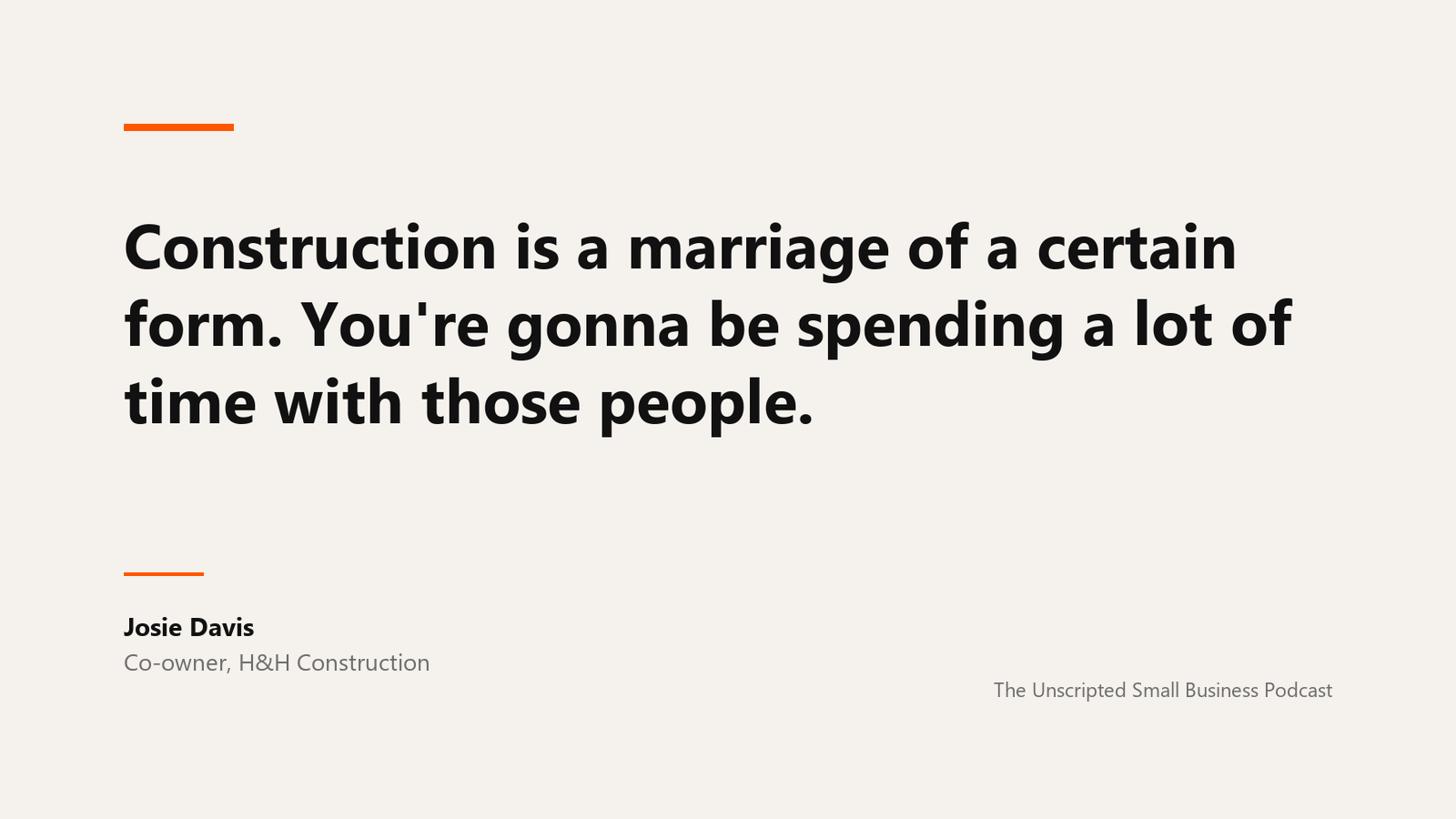
Her ten reviews are all five stars, and that's worth protecting while you grow the count. Ask the customers who would describe the job the way she describes the work. Don't buy reviews, and don't offer anything for them.
Your local SEO checklist for this week
H&H's fix: add Kitchen remodeler as an additional category
It's free and it takes about five minutes in the profile editor. The primary category stays Remodeler, so the general remodeling searches aren't touched. The business already does the work, and customers already say so in reviews. The category is the only place that doesn't.
Set your expectations by the distance table. The two tie-break points, north-west and south-east, are where a category change has the best chance of showing up. The north-east corner, where the showroom is 3.7 km closer, should stay theirs.
A grid is a snapshot of one day, so don't treat any change in the first week as proof.
- Add the missing category today, and change nothing else on the profile so you'll know what moved it.
- Through the month, ask each finished customer for a review in person on the day the job ends.
- In three weeks, re-run the grid with the same keyword, center and spacing, and compare it point by point.
Use OpenSEO to re-run my local rank grid for "[main service]": same center
([address]), same 3x3 size, same 8 km spacing, mobile. Compare it point by
point with my last run from [date]. Tell me which points moved, which
business holds #1 at each point now, and whether my profile changed in
between.
Local SEO reporting for agencies and in-house teams
Agencies and in-house marketers get this job with an extra step: somebody else has to agree before anything changes. An owner who has shrugged at ranking reports for years will believe a grid of their own town with a competitor's name on the squares they lost.
Lead the local SEO report with the grid, name the one fix, and end on the date you'll check it again. The grid shows where to look, but the owner will judge the fix by calls and quote requests from the north end of town. The SEO report skill turns the whole run into a client-ready report.
Use OpenSEO to build a one-page local SEO report for [client], a [trade]
in [town]. Include: their profile audit against the services they sell,
a 3x3 rank grid for their top two services, a side-by-side with whoever
wins the most points they lose, and one recommended fix. Write it for the
owner, not for an SEO: plain language, no jargon, and end with the date
we'll re-check.
Why your business isn't showing on Google Maps across town
If you show up at your front door and disappear a few miles out, check Google's three questions in this order: distance, which you can't change; your business category, which takes five minutes to fix; and your Google reviews, which take months. For H&H, the gap was a category that didn't say "kitchen" and a review count 6.7 times smaller.
For a second opinion on where to start, the free competitor keyword finder shows what the business beating you ranks for, the free backlink checker shows who links to it, and OpenSEO runs each check on this page. It's $10 a month with $10 of usage credits included, and signing up is free with $0.50 of trial credits.
