Local rank tracking: your position depends on where the searcher is standing
For a local business there is no single rank, only a rank at a point on the map. A nine-point grid around one Tennessee service company showed four different businesses holding number one, and the company itself nowhere in the set.
Why a local business cannot have one rank
Ask Google for a plumber from the north side of a town and from the south side, three kilometres apart, and you get two different map packs. Neither is wrong. Google weights proximity heavily for local queries, so the answer moves with the searcher, and a rank tracker that checks from one fixed point reports one of the many answers as if it were the answer.
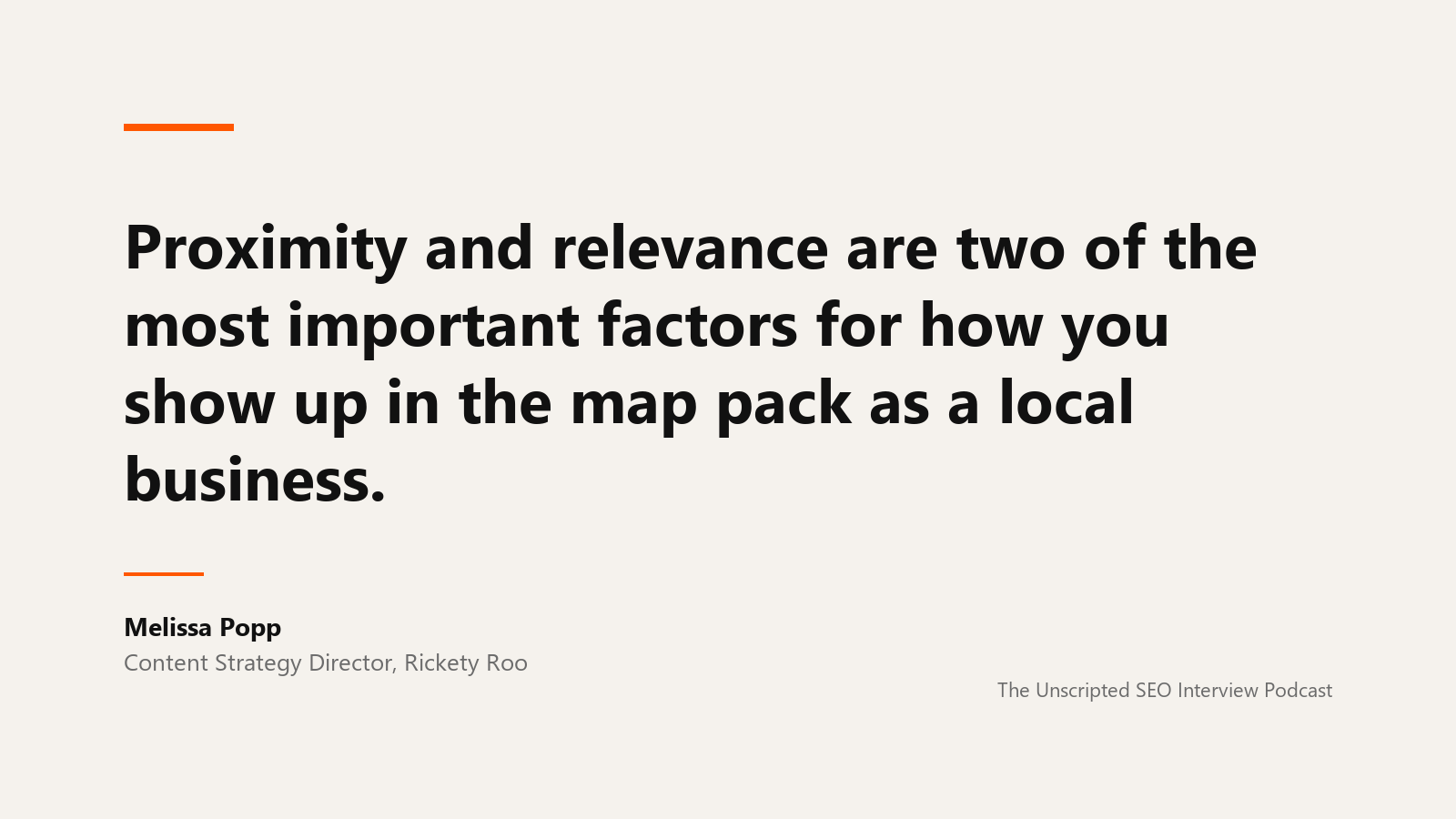
Melissa Popp, content strategy director at Rickety Roo, states the rule most local SEOs work from:
we know proximity and relevance are two of the most important factors for how you show up in map pack as a local business
Her episode on fixing your Google Business Profile before anything else is on the Unscripted SEO podcast. The implication for tracking is that a local business needs its position measured from several places, not one, or the number will describe the tracker's location rather than the customer's.
What a nine-point grid showed
Here is the shape of the problem on a real business: an HVAC and plumbing company in a mid-sized Tennessee town. I ran a three-by-three grid, nine points three kilometres apart, centred on the town, on mobile, for two queries.
For plumber cookeville tn, the number one result was a different business depending on the point. One plumber held the top spot across the north and west, a larger plumbing, heating and cooling company held the centre and the south, a third business took the east and south-east, and a fourth appeared at a single north-east point. Every point returned 18 to 20 results.
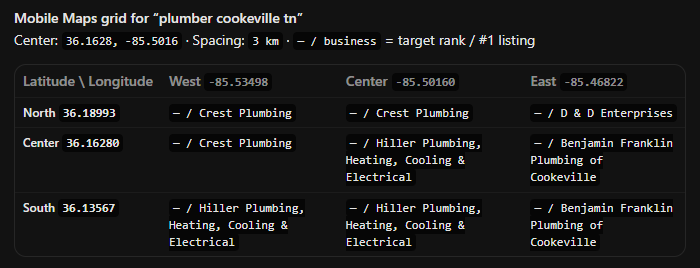
For hvac repair cookeville, the split was cleaner: one company held number one at seven of nine points and a second company took two of the three points along the southern edge.
So over a six-kilometre square, a searcher could be shown five or six different businesses at number one depending on which query they typed and where they typed it. A single-point tracker reporting "position 1" or "position 4" for this town would be reporting one of those cells and calling it the market.
The company I was checking on appeared at none of the eighteen points. The grid's name-match returned nothing, and a listings search within 15 kilometres found no business under the name the company uses on its website. That is a finding in its own right, and it comes before any question of rank: the first thing a local grid tells you is whether you are in the set at all. If the profile exists under another name, that name needs to go into the tracker; if it does not exist, no amount of rank tracking will find it.
Storefront or service area
Set up your Business Profile to match how you serve customers. Google allows eligible hybrid businesses to show a storefront address and a service area when they both receive customers and travel or deliver to them. If customers do not visit your address, hide it and list the area you serve.
Melissa describes the difficulty of competing across locations:
it can be a lot easier to rank an actual brick and mortar location than it can be a service area page because you open up the competitiveness
Choose the profile settings that describe your business accurately. You can also build useful location pages for the neighbourhoods and towns you serve to reach customers through organic website results. Map positioning to real demand covers finding which of those towns search for it.
Which points to track
Run a Maps grid to survey your visibility, then repeat it with the same settings to compare positions over time. Choose points where your customers search. Melissa's method for finding them:
there's also testing that needs to be involved there to figure out, know, like what areas, you know, looking in GA4 and other analytics tools, you know, where are people searching from down to at that city level
That gives you two to five named places. Separately, OpenSEO rank trackers measure your website's organic rankings from a chosen location. They do not track your Business Profile's Maps position. A business serving three towns can use three small trackers to follow its organic results. Twenty keywords in three locations is 60 checks a week, which on the queued schedule is about $0.60 a month.
The grid itself is priced per point: a 3x3 grid is nine Maps searches, a 5x5 is twenty-five, and the app shows the cost before it runs. Use the 3x3 for a quarterly survey and the 5x5 when you are deciding whether to open or list a second location.
What to do with a bad grid
If you rank well at the centre and fall off two kilometres out, that is proximity doing what proximity does, and the fixes are the ones Melissa puts first: a complete, accurate profile in the right category, reviews you answer, and hours and contact details that are correct. If you rank badly everywhere, check the category and the name before anything else. And if you are absent, as the company above was, the tracker has done its job on the first run by telling you the problem is upstream of rankings.
This is also a budget conversation. Melissa on the size of budget she can work with:
I can work with $500. It doesn't mean that we are going to have all the results we want in six months or a year. But I can move the needle with $500
A local grid and three small trackers are a few dollars of that, and they are what stops the other $490 being spent on the wrong town.
Run this with the OpenSEO MCP
Connect the OpenSEO MCP: use the grid for Maps positions and a rank tracker for organic website rankings. The local-seo skill packages this workflow.
Using the OpenSEO MCP on project [name] for [business name] at
[address or coordinates]:

1. Search local businesses within 10 km for "[business name]" and
   confirm the listing exists. Give me its exact title, its cid, and
   its primary category. If nothing matches, stop and tell me.

2. Run a 3x3 local rank grid, 2 km spacing, on mobile, for
   "[main service] [town]", using the cid from step 1 as the target.
   Show me the rank at each point and the business holding #1 at
   each point.

3. Repeat for "[second service] [town]".

4. Summarise: at how many of the 9 points am I in the top 3, how
   many in the top 10, and which competitors hold #1 where I do not.

5. For organic website rankings, separately create one rank tracker
   per location I name, weekly, mobile, depth 20. Estimate the cost
   with 20 keywords each before adding anything. Explain that these
   trackers do not measure Maps positions.
Step 1 is the one that would have saved the company above a quarter of guessing. Match on the cid, not the name, once you have it.
Local rank tracking FAQ
Why do my local rankings look different on my phone and my colleague's?
Because you are standing in different places, or Google thinks you are. Proximity is one of the strongest signals for local queries, so two searchers a few kilometres apart routinely see different map packs. A tracker that checks from one point reports one of those views.
What is a local rank grid?
A set of searches run from points on a grid around a location, usually 3x3 or 5x5, reporting where a business ranks at each point. It shows how far a business's visibility reaches and where competitors take over, which a single rank check cannot.
How many points should a local rank grid have?
Nine, spaced to cover the area you serve, is enough to see the shape. Use twenty-five when you are making a location decision. Beyond that you are paying for resolution you will not act on.
Should a service-area business set up a service area or an address on Google?
Use the settings that match how you serve customers. An eligible storefront that also visits or delivers to customers can show both an address and a service area. If customers do not visit your address, hide it and list your service area.
Does OpenSEO do local rank tracking?
Yes. The MCP local rank grid measures Business Profile positions in Maps. Scheduled rank trackers measure organic website rankings from a chosen location. Both use credits. On the hosted app, scheduled and live rank-tracker checks require the $10/month plan, which includes $10 of credits.
Run this strategy in OpenSEO
Run the MCP prompt in this guide with OpenSEO. OpenSEO is open source, free to try, and does not require a credit card.