Check that somebody searches for what you call it
Positioning that no one searches for is a marketing problem disguised as an SEO problem. Validate the words before you build a company around them.
Does your positioning have any search demand behind it?
Most keyword research starts after the naming is done. The category is chosen, the tagline is written, the site is built, and only then does anyone check whether the words on the homepage match anything a person types. By that point the words are expensive to change.
The check itself takes minutes. Take the term you use to describe what you sell, and look up whether it has search volume, what the results for it show, and what people search instead. Three outcomes are possible. The term has demand and matching results, so you compete for it. The term has demand but the results answer a different question, so your positioning collides with an intent you cannot win. Or the term has no demand at all, which is the case worth planning for, because it is the most common and the least discussed.
The name with no market behind it
George Little now runs a consultancy with a clear offering. An earlier version of the same company did not survive, and the reason was linguistic:
I had another version of this company that did not succeed a couple of years ago that was basically trying to push fractional creative director. No market for it, no search around it. Speaking of SEO, that's really a good place to start. Is anyone even Googling this? And they weren't. So I realized that what they were Googling was agencies and freelancers and this kind of consultant in between.
Running his term through the tool now shows what he found the hard way:
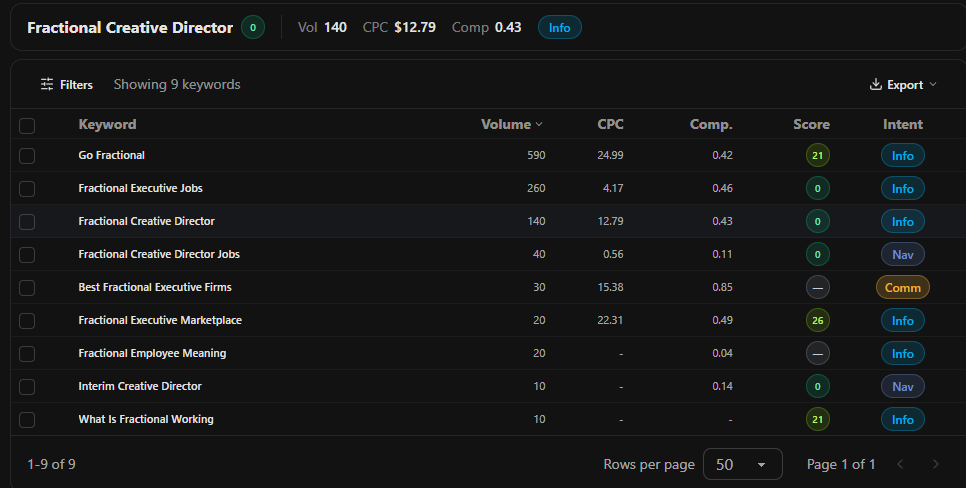
Nine keywords in the entire universe. The term itself does 140 searches a month, and almost everything around it is informational or navigational: people looking up what fractional working means, or searching for jobs. The one term with real volume is a company name. There is no row here belonging to somebody trying to hire this role, which is the demand a business built on the phrase would have needed.
"Is anyone even Googling this" is the whole strategy in five words. Notice what the check gave him beyond a yes or no. It also returned the vocabulary the market does use: agencies, freelancers, and the space between them. A term with no volume is not only a warning. It is a pointer to the words that carry the demand instead.
This is the failure mode behind a lot of category creation. Inventing a name for what you do feels like differentiation, and it reads as differentiation on a pitch deck. In a search box it reads as nothing at all. You can still use the invented term inside the relationship, in sales calls and in messaging where you have someone's attention. What you cannot do is expect it to be the door people walk through.
The opposite case: language that already has a wave behind it
The inverse is more useful, and rarer, because it involves matching demand you did not have to create. Holly Homer learned SEO by accident this way. She wrote a review of a product from a late-night infomercial, and by her own account she had no idea what she was doing:
I parroted the keywords from the infomercial not knowing what I was doing and just would give my two cents.
Her blog ran three to five thousand page views a week. The post took it to a hundred thousand.
It was because I hit the first page. Actually, it was the first result for pajama jean review at the time. And what I found out later was that Pajama Jeans was doing this massive radio campaign. And so people were going to Google and looking for pajama jean information, and they were landing on my blog.
She won by using the exact language a national ad campaign was pushing into people's heads at the moment it was pushing it. She did not invent a term or educate a market. She matched vocabulary that already existed and rode demand somebody else paid to create.
Both stories point the same direction. The words that work are the ones already in circulation, and finding them is seeding from conversation applied to your own positioning rather than your content calendar.
How to validate a name before you commit
Run this before the logo, and certainly before the domain purchase:
- Look up your candidate term and its obvious variants for search volume. Zero volume is a finding, not a dead end.
- Search the term and read the top ten. If the results answer a question you do not answer, the term is claimed by a different intent.
- Look up the terms your customers used in the last ten sales conversations. That list is the demand-side vocabulary.
- Compare. Where your language and their language differ, theirs wins for anything a stranger has to find.
Step four is where people flinch, because the customer's phrasing is usually less distinctive than the one the founders like. Keep the distinctive term for the pitch and the relationship. Use their words on the pages that have to be found by somebody who has never met you.
Do it with OpenSEO
Using the OpenSEO MCP, research "[my category term]" and these
variants: [list]. Report search volume, difficulty, and intent for each.

For any term returning little or no volume, tell me what related terms
DO carry volume, and what the top 10 results for those terms are
selling. I want the vocabulary the market uses instead of mine.

Then compare that list against how my customers describe the problem
in their own words: [paste from sales calls or support tickets].
Show me where my language and their language diverge, and which of
their phrasings I should own on the pages a stranger has to find.
What to do first
Take the phrase on your homepage that describes what you sell, and look up its volume. If the number is zero, the sentence is doing no acquisition work, and the words that would are sitting in your last ten sales calls. That is a cheap discovery to make now and an expensive one to make in a year.
Positioning and search demand FAQ
Should I invent a name for my category?
Only with a plan for the demand gap. An invented term has no search behind it on day one and may never earn any, so anything a stranger needs to find has to be findable through the vocabulary that already exists. Keep the invented term for the pitch, where you have someone's attention.
What if my keyword has no search volume?
Treat it as a signal about the market rather than a limitation of the tool. Zero volume for a category term usually means people describe the problem differently, and the related terms that do have volume will show you how. Low volume is different from zero, and can be worth owning when the intent is strong.
How do I find the words my customers use?
Sales calls, support tickets, and recorded interviews, which is the same source that produces good seed keywords. People describe problems in language that no keyword database originates, because the database only knows what has already been typed enough times to register.
Run this strategy in OpenSEO
Run the MCP prompt in this guide with OpenSEO. OpenSEO is open source, free to try, and does not require a credit card.