One page per intent, one hub per topic
A 500-row keyword list isn't a strategy. Keyword clustering turns it into a site structure and fixes the cannibalization that's splitting your rankings.
What is keyword clustering?
Keyword clustering is grouping keywords that deserve the same page because they share one intent. "Keyword clustering", "keyword grouping", and "cluster keywords for seo" are one cluster, so they get one page. "Best keyword clustering tool" is a different intent, so it gets a different page. The unit of SEO is the cluster, not the individual keyword.
How to cluster keywords into topical hubs (without a $99/mo tool)
- Start from your expanded list. Seeds → expansion → intent labels. You want 100+ rows before clustering is worth it.
- Group by SERP overlap, not word similarity. Two keywords belong together when Google already ranks the same pages for both. Word-match clustering ("keyword tool" + "keyword tool io") produces false groups.
- Name each cluster by its intent. The name becomes the page's working title. If you can't name the intent in one line, the cluster is two.
- Arrange clusters into a hub. The head-term cluster is the pillar page; each subtopic cluster is a spoke that links up. Internal links follow intent adjacency, not chronology.
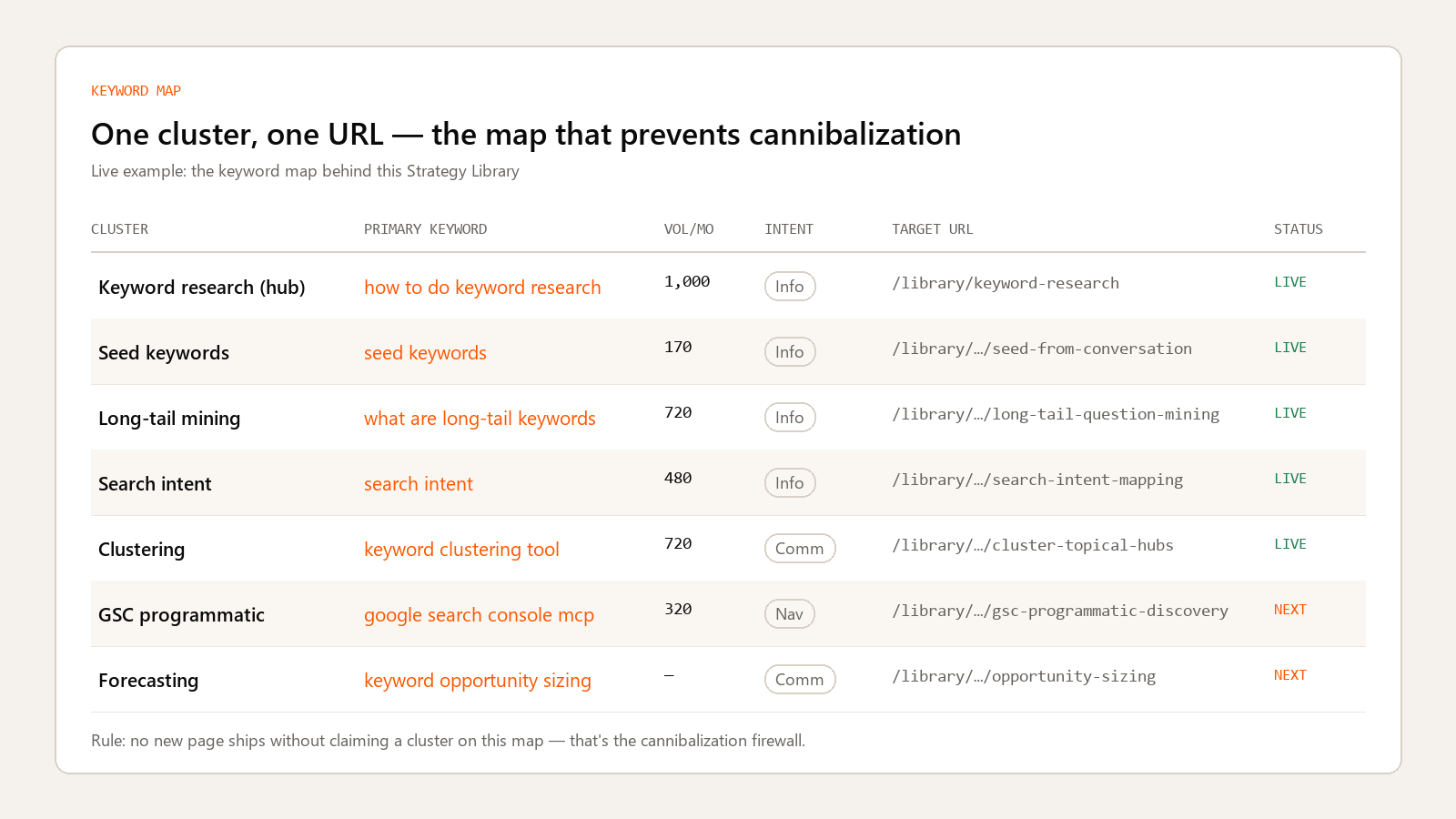
- Map every cluster to one URL, and record it. The keyword map (a simple sheet: cluster → URL → status) is the artifact that prevents future cannibalization.
How to fix keyword cannibalization
Cannibalization is the opposite problem: two of your pages compete for one intent, Google alternates between them, and both rank worse than either would alone.
- Find it: in Search Console, group by query + page. Any query with 2+ of your URLs swapping impressions is a candidate. Programmatic discovery runs the same grouping across every page at once.
- Fix it: merge the weaker page into the stronger (301), or re-point the weaker page at a genuinely different intent and re-title it.
- Prevent it: the keyword map from step 5. No new page ships without checking which cluster it claims.
Run this workflow with the OpenSEO MCP:
Using the OpenSEO MCP + Search Console: pull my queries grouped by
query and page, flag queries where two of my URLs alternate, and
propose merge/redirect fixes. Then cluster my researched keywords
by shared intent and output a cluster → URL keyword map.
Keyword clustering FAQ
What's the best keyword clustering tool?
For SERP-overlap clustering at scale, paid tools exist, but for most sites, OpenSEO's research + an intent-grouping pass (the MCP prompt above) covers it. Judge tools by whether they cluster on SERP overlap; word-similarity clustering is a toy.
Is there a free keyword clustering tool?
Not an unlimited one. The grouping step itself is free (the MCP prompt above does it), but it runs on researched keywords, and quality keyword data is the part that costs money everywhere. OpenSEO includes the clustering pass with research, so there's no separate clustering tool to buy; you can start for free, and paid plans start at $10/month.
What is a keyword mapping template?
A sheet with one row per cluster: primary keyword, supporting keywords, intent, target URL, status. The keyword map above is the working example; copy the structure. Add a forecast column and it becomes a build order: size each cluster before you commit the quarter.
Run this strategy in OpenSEO
Run the MCP prompt in this guide with OpenSEO. OpenSEO is open source, free to try, and does not require a credit card.
