Where the queries happen when they don't happen in Google
Pinterest, LinkedIn and the AI assistants all run on intent, and none of them appear in your keyword tool. The research method carries over; the surfaces do not.
Where does keyword research happen outside Google?
Keyword research assumes one box. A person types, an engine ranks, you measure the click. That model still describes a large share of demand, and it describes a shrinking share of discovery. People look things up inside Pinterest, inside LinkedIn, inside YouTube, and increasingly inside an assistant that answers without sending anyone anywhere.
The discipline transfers cleanly. You are still asking what somebody wants, in what words, at what stage. What changes is that these surfaces publish no volume data, so the research runs on the platform's own autocomplete, on your first-party results, and on the vocabulary your customers already use. That last source is the one that works everywhere, which is why seeding from conversation matters more here than on Google.
Pinterest is a search engine wearing a social network's clothes
Julia Bocchese works almost entirely in Pinterest and SEO, and she is direct about why the two belong together:
Most of the time when people go to Pinterest, they are searching for something. They're not really going there to follow people or to comment on pins. They're really searching for information, ideas, inspiration, products.
That single observation changes what you optimize. On a social network, the account is the unit and the follower is the asset. On a search surface, the query is the unit, and Julia points out the practical consequence: the audience arriving from a Pinterest search has no idea who you are.
People aren't going on Pinterest to follow people. They're searching for information. So they likely don't know who you are.
The optimization work looks familiar as a result. Keywords belong in pin titles, in pin descriptions, in the text rendered on the graphic itself, and in the board and profile copy, because the platform has to understand the account and the pin before it can match either to a search. It is the same two-sided job as a page title and a site structure, run on a surface with no Search Console.
LinkedIn ranks the profile, not the post
Daniel Alfon makes an argument that sounds wrong until you check your own behaviour on the platform:
LinkedIn is the only platform where, Jeremy, you can be successful without posting content. That's amazing. Because if you want to be a successful YouTube or Instagram or TikTok, you have to upload content.
His reasoning is that the most common action on LinkedIn is visiting somebody's profile. The profile is therefore the ranked, keyword-sensitive asset, and the question a visitor arrives with is narrow: is your specialty the specialty they are looking for. His advice follows from that. Take care of the profile, make sure it converts, and treat posting as the secondary activity it is.
For keyword work this means the headline and the about section carry the load a title tag carries elsewhere. They should contain the words a stranger would use to describe the problem you solve, not the internal job title your company assigns you.
The assistants answer, and the click never arrives
The third surface is changing fastest: ranking and traffic have come apart. Christopher Gimmer, running a site with a decade of authority behind it, describes the split:
Even though we're ranking number one for some of these keywords, the AI Overviews are answering some of those things, and so we're losing out on some of those clicks.
He adds a second erosion that has nothing to do with AI. On commercial queries the paid block has grown to the point where position one is not position one on the page:
Even if you're ranking number one for that organic keyword, your link is actually the fifth one on the page. And if you're ranking number three, you're now like eight links down.
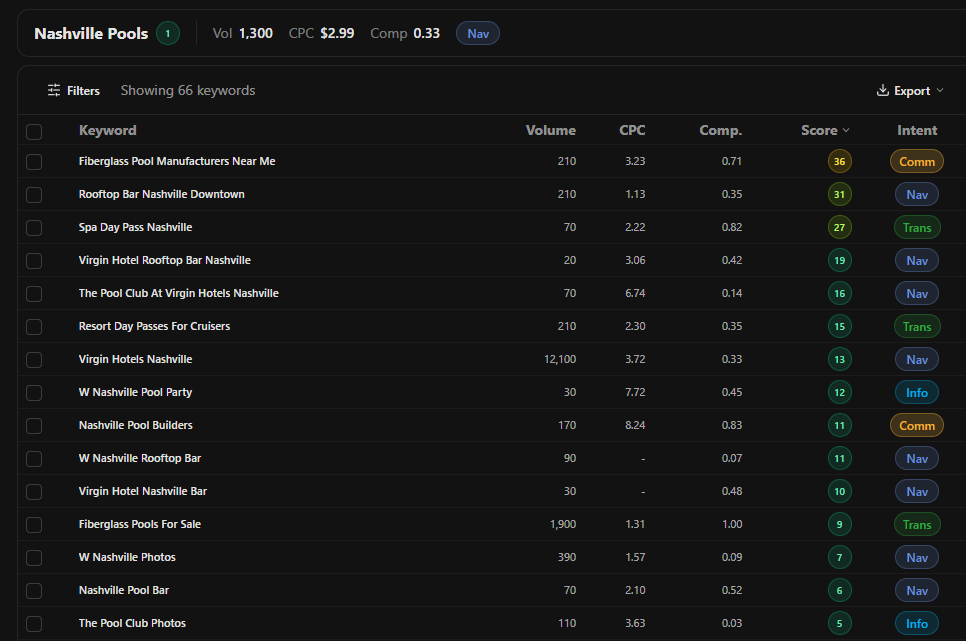
The intent column is the closest native proxy for this. The rows labelled informational are the ones an assistant can satisfy without sending anyone anywhere, and the transactional and commercial rows are the ones that still end in a visit. Reading the list that way tells you which part of your research is exposed to the answer layer before you commit to any of it.
Two lessons for research. First, rank is a weaker proxy for traffic than it used to be, which is why forecasting should apply a CTR curve that reflects the SERP you face rather than a textbook one. Second, informational queries that an assistant can satisfy in a paragraph are worth less than they look in a volume column, and queries requiring a tool, a login, a price or a human are worth more.
How to research a surface that publishes no volume data
None of these platforms will hand you a search volume. The method that works without one:
- Type your seed into the platform's own search box and record the autocomplete suggestions. That list is the platform telling you what people search there.
- Read the top results and note the vocabulary they use in titles and opening lines, which is the language the platform has already rewarded.
- Check your own first-party data for the platform, where it exists, before trusting any of the above.
- Look for the branded lift. Discovery on a platform with no outbound links often shows up later as somebody searching your name in Google, which is the one measurable bridge back.
Point four is the measurement most people skip. If a platform sends no clicks, watch whether branded search grows while you invest there. It is a directional signal you can monitor in your own Search Console.
Do it with OpenSEO
The keyword work still needs a demand baseline, and Google remains the best available proxy for what people want even when they ask somewhere else.
Using the OpenSEO MCP, research keywords for "[my topic]" and label
each result by intent.

1. Split by surface
Flag which of these queries an AI assistant can fully answer in a
paragraph, and which need a tool, a price, a login or a human. Rank
the second group higher: those are the queries that still produce a
visit.

2. Branded baseline
Pull my branded queries and their trend over the last 12 months. I am
going to invest in [platform], which sends no referral data, so I want
the branded line as my before-picture.

3. Vocabulary
For my top 10 non-branded queries, give me the phrasings a person
would use searching inside Pinterest or LinkedIn rather than Google:
shorter, more visual, more role-based.

Output as a document I can review.
What to do first
Take one seed and run it through the search box of whichever platform your customers use. Compare that autocomplete list against the keyword list you already have. The overlap tells you what carries across surfaces. The gap is the demand your current research has never seen, and it is usually phrased in words no keyword database would have suggested.
Keyword research beyond Google FAQ
How do you do keyword research for Pinterest?
Use the platform's own search box and its guided-search suggestions, then place those terms in pin titles, pin descriptions, the text on the image, and your board and profile copy. Pinterest has to understand the account and the pin before it can match either to a query, so both levels need the vocabulary.
Does SEO work for LinkedIn profiles?
Yes, and the profile matters more than the posting. The most frequent action on the platform is viewing a profile, so the headline and about section carry the weight a title tag carries on a website. Write them in the words a stranger would use for the problem you solve.
How do you optimize for AI assistants?
Answer questions directly and completely enough to be quotable, and accept that queries an assistant can satisfy in a paragraph will return fewer clicks regardless of your rank. Weight your research toward queries needing a tool, a price, a login or a person, because those still send a visit.
How do you measure traffic from platforms that send no referral data?
Watch branded search. Discovery on a closed platform tends to surface later as people searching your name, so a rising branded line in Search Console during a campaign is a useful directional signal.
Run this strategy in OpenSEO
Run the MCP prompt in this guide with OpenSEO. OpenSEO is open source, free to try, and does not require a credit card.