The Dark Query Problem: Why Search Console Hides Most of Your Searches
Google shows you the clicks but hides the questions behind them. Here's how to triangulate the searches you can't see using data you already have.
Open any page report in Google Search Console. It will tell you, confidently, that this page earned 100 clicks last month. Scroll to the query table underneath, and Google will name maybe seven to fourteen of the searches that drove them. The other 86 clicks came from searches Google won't show you, anonymized away under privacy thresholds.
Those are dark queries: real searches, from real people, that turned into real visits, and you have no idea what they were.
You can't force Google to hand them over. But you can reconstruct most of them, and the data you need is already sitting in three tools you probably already use. If you want an agent to do the heavy lifting, connect OpenSEO MCP first so it can pull live keyword, ranking, SERP, and Search Console data. New to this? Start with the SEO coach.
Table of Contents
- The 100-clicks, 14-queries problem
- Why the gap is getting worse, not better
- The fix: triangulate three data sources
- Do it with OpenSEO
- What to do Monday morning
The 100-clicks, 14-queries problem
It's not a rounding error you can wave off. Knowing you got a hundred clicks but only seeing fourteen of them is, as I've described it, "sticking your finger in the air." It's nice to know the number exists. But fourteen out of a hundred is not a usable level of data, not if you're trying to decide what to write next, which page to expand, or what your audience actually wants.
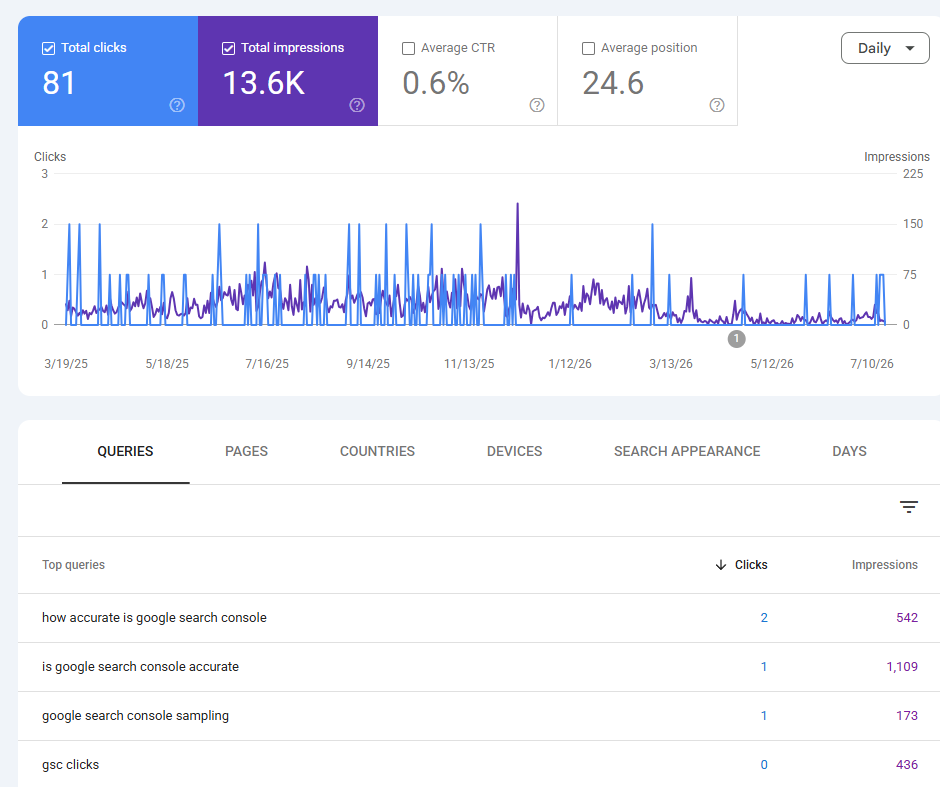
This is the quiet frustration underneath most content planning. I talked about it recently with Sonia Urquilla, who runs SEO by Sonia and works almost entirely with founders and coaches who don't have a big analytics team. When I brought up the query gap, her reaction was immediate:
This is the one complaint that all of us always have. Everywhere I go, search or when I hear podcasts, we always complain about these numbers, the analytics. Please give us something that can help us solve that.
For her clients, the gap isn't an academic annoyance. It's the difference between a content plan built on evidence and one built on a guess.
Why the gap is getting worse, not better
Here's the part that should worry you: dark queries are the old version of this problem. The new one is that entire channels are going dark.
When a prospect asks ChatGPT for "an affordable keyword tool for a freelance SEO" and your brand gets recommended, that lead can arrive with no referrer, no query, and no row in any dashboard. Search Console at least admits it's hiding data from you. The AI answer layer doesn't even do that.
Sometimes my clients get a lead from ChatGPT, but I'm not able to see that data yet, to see what worked for them. I just want to condense that data.
— Sonia Urquilla, SEO by Sonia
So we're living with two layers of dark data now: the queries Search Console withholds, and the AI-driven visits that never announce themselves at all. You can't fully close either gap. But you can shrink the first one dramatically, and the discipline that does it is the same one you'll need for the second: stop treating any single tool as the source of truth, and start triangulating.
The fix: triangulate three data sources
No single dataset can rebuild your dark queries. But you already hold three partial views of the same page, and each one knows something the others don't:
- Search Console gives you positioning: the ~14 named queries, their average rank, impressions, and CTR.
- Google Analytics gives you the real organic traffic and behavior for the landing page: sessions, engagement, conversions.
- Rank tracking gives you the rough rankings for the broader keyword cluster the page could plausibly be catching.
Line those three up against a single URL and the shape of the missing 86% starts to emerge. If a page shows 100 clicks, ranks on page one for a cluster of twenty related terms, and Analytics confirms a wave of engaged organic sessions, you can reasonably infer which unnamed queries are doing the work, even though Google never spelled them out. It isn't certainty. It's triangulation: a defensible suggestion instead of a finger in the air.
Do it with OpenSEO
This is exactly the workflow the OpenSEO MCP was built for. Because the Google Search Console connection runs through OpenSEO, you don't have to wire up a separate integration. Connect it once and query all three sources from the same agent.
1. Pull the honest positioning picture
Ask your agent to grab the Search Console performance for one URL and flag the click-to-named-query gap.
2. Widen the keyword cluster
Use OpenSEO's ranked-keywords and keyword-research tools to find every term the page could plausibly be catching, not just the fourteen Google admitted to. The keyword research skill makes this repeatable.
3. Confirm against real traffic
Bring in Google Analytics (or your choice tool) to check the inference against actual organic behavior for the landing page.
Full Prompt: See Dark Queries
1. Pull the positioning picture

Look at [yourwebsite.com/page] in Search Console for the last 90 days.
List total clicks vs. the sum of clicks in the named-query table, and
show me the gap. Then give me the ranked keywords and their average
position for this exact URL.

2. Widen the keyword cluster

For that same URL, pull all keywords it ranks for in positions 1-20.
Cluster them by intent, then flag which clusters are NOT represented
in the named Search Console queries. Those are my likely dark-query
candidates.

3. Confirm against real traffic

Pull organic sessions and engagement for this landing page over the
same window. Where engaged-session volume is far higher than the named
clicks can explain, tell me which inferred query clusters most likely
account for the difference. Output as a document I can review.
The output isn't a magic list of the exact hidden searches, that data genuinely doesn't exist on your side of Google's wall. What you get instead is a ranked, evidence-backed shortlist of what those dark queries almost certainly are, assembled from three sources that individually would have left you guessing. That's the difference between "I got a hundred clicks" and "here are the twelve topics actually pulling people to this page, and here's the one I should build the next article around."
Expensive suites will happily charge you $100 to $200 a month and still hand you the same fourteen queries. The point of doing this in OpenSEO isn't a prettier dashboard, it's that the Search Console, ranking, and MCP pieces are already connected, cheap, and scriptable, so triangulation becomes a prompt instead of a project.
What to do Monday morning
Pick your single most important page, the one you'd most hate to be guessing about. Run the three steps above against it. You'll walk away with a concrete list of topics to expand and, more usefully, a repeatable habit: never trust one tool's version of what your audience searched for.
As Sonia's clients keep proving, the leads increasingly arrive from places nobody used to look. The SEOs who win the next few years won't be the ones with the most data. They'll be the ones who got good at reconstructing the data everyone else accepts as lost.
If you want to explore this yourself, OpenSEO is an affordable, open-source SEO tool that connects Search Console, ranking, and MCP data in one place, so you can start closing the dark-query gap today.
