What Broke the $99 Ceiling
A decade of indie SEO tools died against a price comparison they could not win. The thing that finally opened the market was not a cheaper tool, it was the collapse of the twenty hours a week it took to use one.
Everybody has spent fifteen years complaining that SEO tools cost too much, so you would expect a $10 alternative to be the headline. The price was never what stopped you.
I spent years inside this problem. Raven Tools brought me out of Homes.com and out to Tennessee, and back in 2008 to 2010, alongside Moz, before Ahrefs was a thought anybody had had, we were one of the better known SaaS tools in the space. I watched what happened to every indie tool that came after us, and it was always the same two questions.
Is that already in Semrush or Ahrefs? And do I need to pay for this on top of Semrush?
If you want an agent to run the audit at the end of this post, connect the OpenSEO MCP first so it can pull your live ranking and Search Console data.
Table of Contents
The ceiling nobody could price above
Those two questions built a ceiling at $99 a month, and that ceiling killed a decade of good software.
Price under $99 and you were a toy, useful but not something a team would build a process around. Price over $99 and you got compared to the full Semrush suite on day one, and unless you had all of it, you lost. Every indie SEO tool had two options: play small forever, or jump to enterprise and skip the middle.
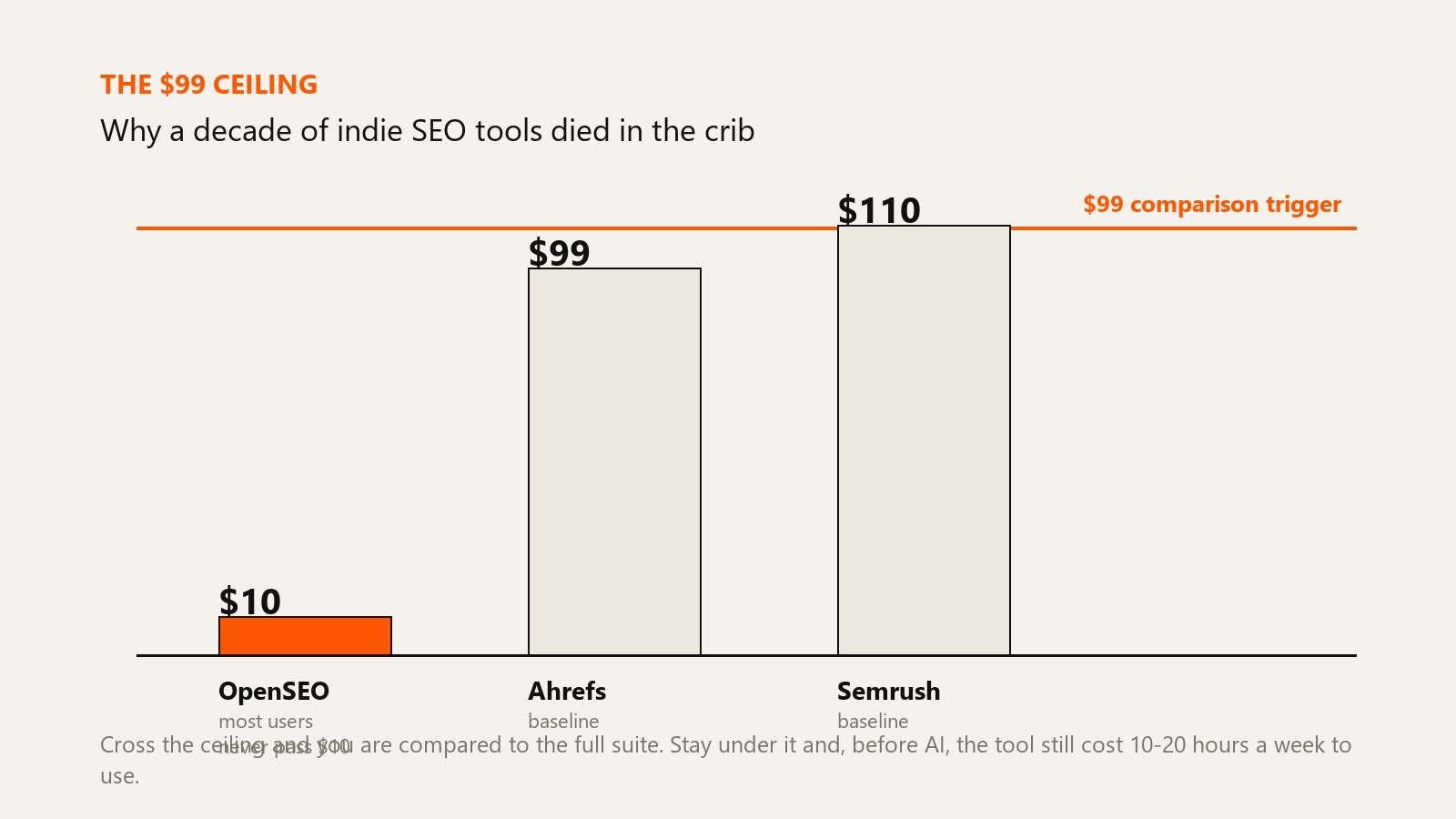
That ceiling was real and it held for a decade. Moz Pro has listed a $99 entry tier continuously since at least February 2016, which four separate archived snapshots confirm, and the tier above it drifted between $149 and $179 over the same period. The stability of the $99 line is the notable part.
One correction to the story I used to tell, though. The market converged on $99 rather than starting there. Ahrefs Lite was $79 a month in December 2015 and Semrush Pro was $69.95 in mid-2015. Both climbed to roughly $99 by 2017 and stopped. So this was a ceiling the market found, not one it was born with.
What actually changed
When Ben Senescu told me OpenSEO runs at $10 a month, my first read was that somebody had finally undercut the ceiling. That is not what happened, and the real answer is more useful to you.
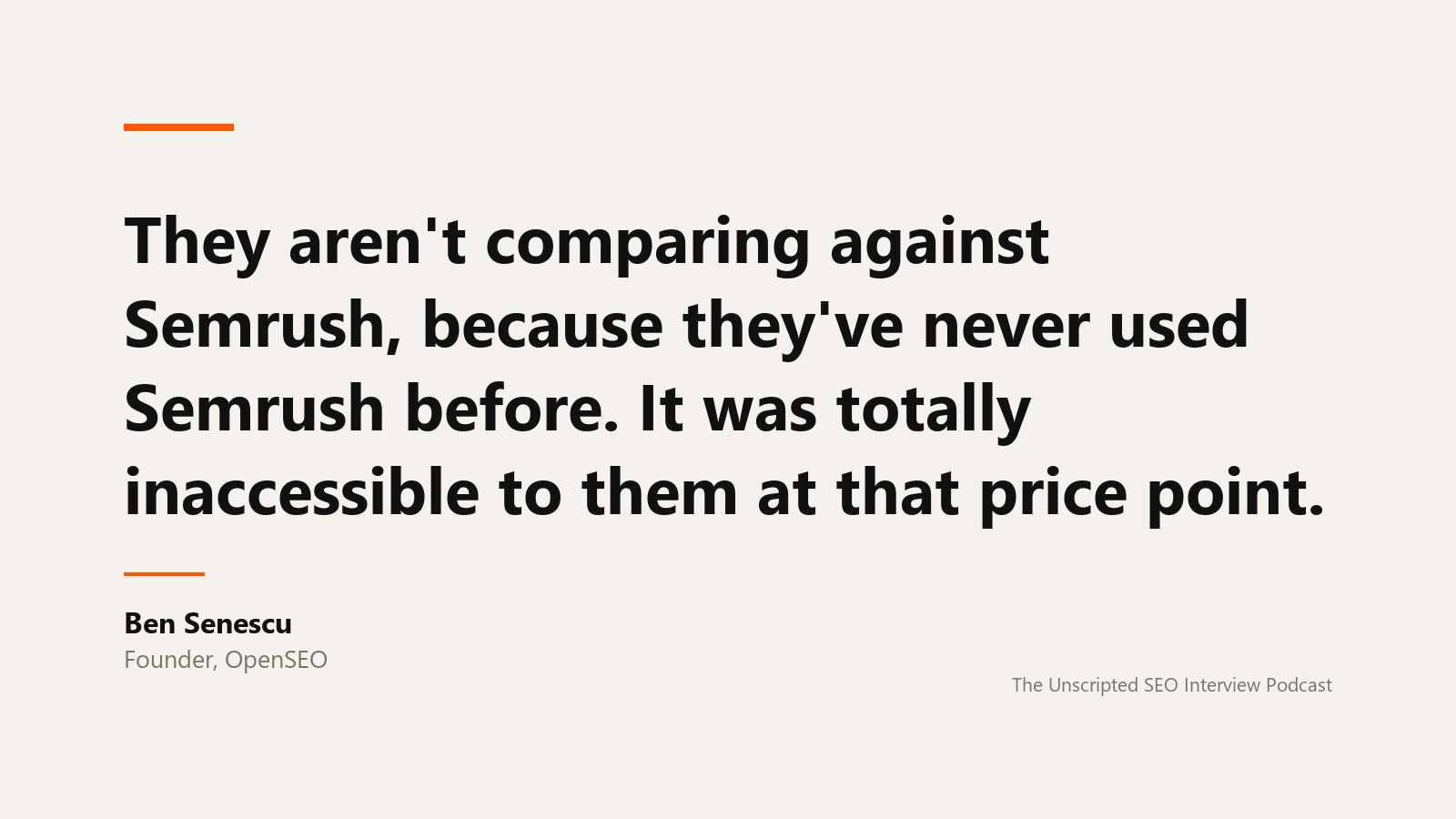
His paying customers are not professional SEOs. They are entrepreneurs doing SEO for the first time, people who never had the $110 option, so they are not comparing anything. The reason they can do it now is that the work got cheap.
Think about what an hour of SEO used to cost you in time. You wanted to change a meta title, so you downloaded a plugin, and you had to know Yoast existed to know which plugin. Then you logged into WordPress, found the page, opened it, waited for it to load, made the change, saved it, and checked it. Ten minutes to edit one string. Everything else lived in spreadsheets, then a Google Doc, then another spreadsheet, then copy, paste, copy, paste.
That was the real bill: ten to twenty hours a week. Against twenty hours a week, the difference between a $10 tool and a $100 tool was a rounding error, which is why cheap tools never found a market. They solved the small half of the problem.
Once the twenty hours collapses, the hundred dollars starts to matter. That is why this market exists now and did not exist two years ago.
Worth being accurate about the pricing, since it is the whole argument: OpenSEO is $10 a month and free to start, and it is not free in the sense people usually mean. Good SEO data costs money everywhere, which is why every serious suite lands near the same number. You either bring your own DataForSEO key or pay a small fee on top of the data you use.
Your constraint moved
If you sat out SEO because the tooling was priced for agencies, the door is open. The useful takeaway is not "go buy a cheap tool." It is that your constraint moved and you probably have not moved with it.
- Execution used to be the bottleneck. It is not any more. You can generate more work in an afternoon than you can evaluate in a week.
- Judgement is the bottleneck now. Which of these things is worth doing, and what do you leave out? No tool answers that.
- The people who do well over the next two years will be the ones who get good at saying no, rather than the ones who get good at prompting.
Ben put this better than I would have, and he was talking about his own roadmap when he said it:
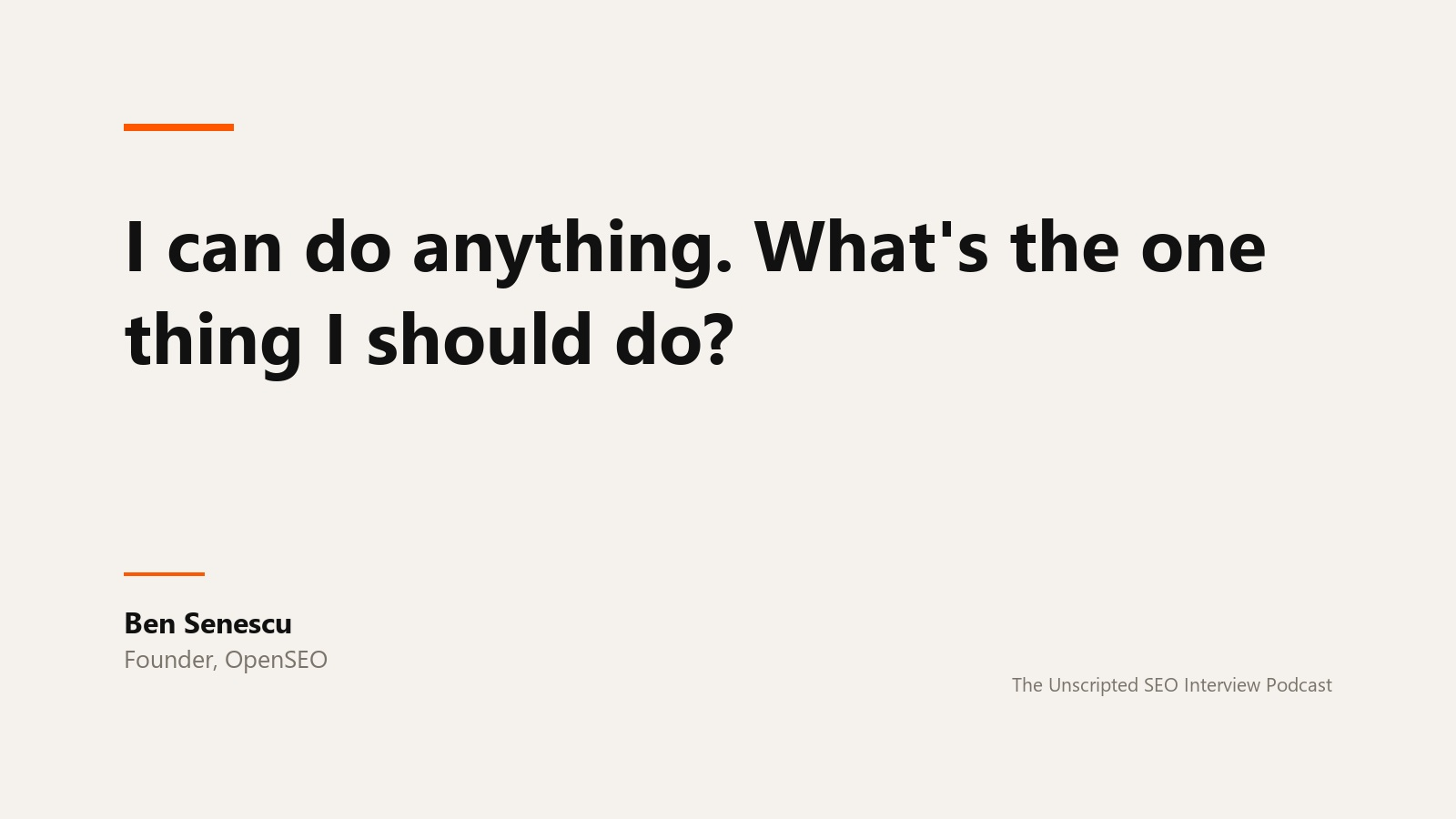
He had roughly sixty open pull requests from strangers, and by his own account most of them were probably good work. He declared bankruptcy on the queue, published a roadmap explaining why, and stopped taking external code. That is uncomfortable to write and it is also the job now.
The cost nobody is pricing in
I do not want to hand you a clean story, because this swap has a bill attached.
When it takes ten minutes to edit a meta title, you think about whether the title is right. When it takes four seconds, you do not. You can produce a hundred pages that are each ninety-five percent correct and never find the five percent, because the errors do not cluster. They sit evenly across everything you made. Ben said the same about features, and it applies to content, redirects, schema, and most of the rest of this job.
The discipline that friction used to enforce now has to come from you, which is a harder ask than it sounds, and I do not think many people have noticed the swap.
Do it with OpenSEO
Here is the audit I would actually run this month, and it takes about twenty minutes.
1. List what you would build if you had unlimited time
Write it all down. Twenty items, forty, however many. This is the part that used to be constrained and is not.
2. Mark which items a model can finish without you
Be honest. Most drafting, most technical cleanup, most first-pass keyword work.
3. Circle the ones that need your judgement
Positioning. Who you are for. What to leave out. Which client to say no to. That list is short, and it is the only list that matters now.
Full Prompt: Find the work only you can do
Using the OpenSEO MCP, pull my current ranked keywords and top pages.

Then, for each item on this list of planned work:
  - <paste your list>

1. Classify it as EXECUTABLE (a model can complete it end to end) or
   JUDGEMENT (it needs a decision about positioning, audience, or tradeoffs).
2. For EXECUTABLE items, say what data you would need from OpenSEO to start.
3. For JUDGEMENT items, write the one question I have to answer first.
4. Return the JUDGEMENT list, shortest first.
Then go and do the judgement list yourself, carefully, and let the tooling take the rest.
The tooling got cheap. Your attention did not.
Ben Senescu is the founder of OpenSEO. He joined me on The Unscripted SEO Interview Podcast on 13 August 2026; the full conversation is here. Historical pricing was checked against archived vendor pages, and current pricing against each vendor's own pricing page, on 2 September 2026.
